

Stray Current, Galvanic, and Anaerobic Corrosion:
Protecting Your Rainman
Executive Summary
On rare occasions, we run across Rainman customers having uncommon corrosion issues. This will typically be related to stray currents, dissimilar metals, or incorrect storage of the system.
Three processes cause most metal corrosion on boats, and your watermaker sits in the path of all of them. Galvanic corrosion occurs when two different metals, such as a brass fitting threaded onto stainless steel plumbing, are connected in seawater. The metals form a weak battery and the less noble metal slowly dissolves. Stray current corrosion is caused by an electrical fault on the vessel, such as a chafed wire in the bilge or a faulty shore power connection. Current flows through your fittings into the water and can destroy in days what galvanic action would take years to damage. Anaerobic corrosion occurs when metal sits in oxygen-starved water, most commonly when a unit is stored wet in a sealed enclosure. Deprived of oxygen, even marine grade stainless steel loses its protective surface film and can suffer severe damage within weeks.
All high pressure salt water plumbing in your Rainman watermaker is 316 stainless steel, which minimises these risks. However, adding brass fittings to the salt water path reintroduces the galvanic problem, and no metal is immune to stray current or anaerobic attack.
Prevention is simple and inexpensive. Keep the salt water path stainless steel or plastic from end to end and avoid common brass fittings in seawater service. Keep DC wiring out of the bilge, sealed and properly fused, and fit a galvanic isolator on shore power. Maintain your sacrificial anodes, and treat rapidly disappearing anodes as a warning that stray current may be present. Finally, care for the watermaker itself: fresh water flush after use, pickle at the correct concentration for storage, and never store the unit wet in a sealed enclosure. The article below explains each mechanism and how it applies to your Rainman system, and finishes with a prevention checklist.
Three Types of Corrosion
Boaters often use the word “electrolysis” to describe any electrical corrosion. There are actually three distinct mechanisms that matter for your watermaker. The distinction matters because they are diagnosed and prevented differently.
Galvanic corrosion is a natural battery effect. When two dissimilar metals are electrically connected and immersed in an electrolyte such as seawater, the less noble metal becomes an anode and slowly dissolves, while the more noble metal is protected. No external electricity is required. The potential difference between the metals themselves drives the current. Galvanic corrosion is slow, typically measured in months or years.
Stray current corrosion occurs when an external electrical source drives current through metal fittings and into the water. Common causes are a chafed wire in the bilge, a faulty bilge pump, a leaking battery charger, or a miswired shore power connection. The metal where current exits into the seawater corrodes. Stray currents can be many times larger than galvanic currents, so the damage is much faster. A fitting that would survive years of galvanic attack can be destroyed in days or weeks. Stray current corrosion does not respect metal nobility. It will corrode bronze, brass, and stainless steel wherever current leaves the metal surface.
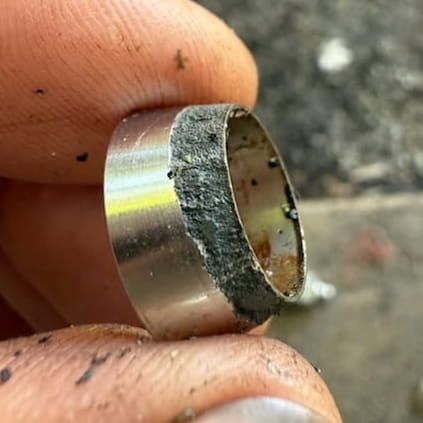
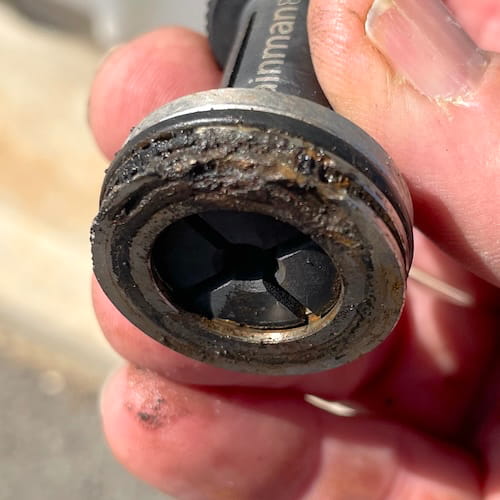
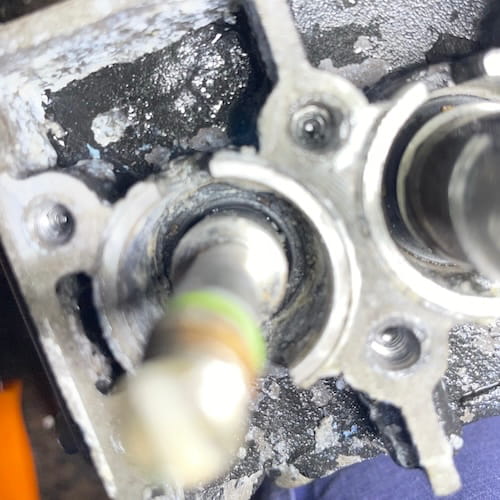
Anaerobic corrosion is different from the two electrical mechanisms above: it is driven by chemistry rather than an electrical couple or fault. It occurs when metal sits in stagnant, oxygen-depleted water — trapped seawater inside fittings, or moisture sealed inside an unventilated enclosure. Stainless steel depends on oxygen to maintain its protective surface film, so oxygen starvation strips it of the very property that makes it “stainless”. Oxygen-free conditions also favour bacteria that produce hydrogen sulfide, which is aggressively corrosive to virtually all metals. Anaerobic corrosion can cause severe damage in as little as one month.
A useful rule of thumb: slow, predictable wasting of the least noble metal in a pair indicates galvanic corrosion. Fast, aggressive, often localised destruction indicates stray current. Widespread black or brown attack on a unit that has been stored wet and sealed indicates anaerobic corrosion.
How Stray Current and Galvanic Corrosion Works
Every galvanic or stray current corrosion cell needs four things: an anode, a cathode, an electrolyte, and a conductive path between anode and cathode. Remove any one of the four and corrosion stops.
Each metal sits at a characteristic voltage on the galvanic series in seawater. Approximate potentials, measured against a silver/silver-chloride reference:
|
Metal
|
Approx. potential (V)
|
Position
|
|---|---|---|
|
Magnesium
|
−1.60
|
Most anodic (corrodes first)
|
|
Zinc
|
−1.00
|
Anodic — used for sacrificial anodes
|
|
Aluminium alloys
|
−0.75 to −1.00
|
Anodic
|
|
Mild steel
|
−0.60 to −0.70
|
Anodic
|
|
Brass (yellow, 60/40)
|
−0.30 to −0.40
|
Mid-series
|
|
Bronze
|
−0.26 to −0.31
|
Mid-series
|
|
Copper
|
−0.30 to −0.36
|
Mid-series
|
|
316 stainless steel (passive)
|
−0.05 to −0.10
|
Noble (protected)
|
|
316 stainless steel (active)
|
−0.43 to −0.54
|
Behaves like mild steel
|
|
Titanium
|
~0.0
|
Very noble
|
Two points from this table matter for your watermaker:
- The larger the potential gap between two coupled metals, the faster the less noble one corrodes. Brass coupled to 316 stainless steel in seawater gives a gap of roughly 0.2 to 0.3 volts, enough to cause damage over a season.
- 316 stainless steel appears twice in the table. With oxygen present, its chromium oxide surface film makes it noble and highly corrosion resistant. Deprived of oxygen, such as under a hose clamp, inside a stagnant fitting, or beneath a salt deposit, the film breaks down and the same metal corrodes by pitting and crevice attack. This oxygen dependence is also the key to the third mechanism, anaerobic corrosion, covered in detail below. It is why marine grade stainless steel can still fail in places you cannot see.
Anaerobic corrosion does not need the four-part electrical cell. Its driver is the chemistry in point 2 taken to the extreme. Stainless steel’s corrosion resistance comes entirely from that thin chromium oxide film, and the film needs oxygen to maintain and repair itself. In stagnant, sealed conditions the trapped water consumes the available oxygen, the film cannot regenerate, and the steel is left in its “active” state, behaving more like mild steel than marine grade stainless. Oxygen-free conditions additionally favour sulfite-reducing bacteria, which thrive in stagnant seawater and produce hydrogen sulfide, a gas aggressively corrosive to virtually all metals. So where a galvanic couple corrodes one metal while protecting the other, and stray current attacks wherever current exits into the water, anaerobic corrosion attacks every metal surface in the oxygen-starved space.
Rainman Design Considerations
Rainman put significant thought into minimising opportunities for galvanic corrosion to affect the lifespan of our systems.
Lift Pumps
We use two different lift pumps on the various Rainman models. They are made from either marine grade bronze or dezincification-resistant (DZR) brass, which have significant workmanship benefits over stainless steel. Both manufacturers of our lift pumps install 316 stainless plates on their pumps. 316 stainless has been found over many years to outperform brass or bronze for this part. This is because it is a high wear part, and stainless stands up to the constant friction from the rubber impeller far better than brass/bronze. These dissimilar metals do not cause galvanic corrosion issues because the wetted area of the noble metal (the cathode) is much smaller than that of the active metal (the anode), so the small amount of current from the small cathodic surface is considerably dissipated over a much larger anodic surface.
Overpressure Valve
One challenging area for galvanic corrosion is the overpressure valve. Spring loaded overpressure valves are closed (their normal state) by a needle being pushed against a valve seat with considerable spring force. In order to achieve a good seal and prevent sticking, the tip of the needle needs to be of a significantly harder material than the seat, which raises the potential for galvanic corrosion caused by dissimilar metals. Rainman has circumvented this by designing the overpressure valve in our 140L and 35L systems with a 316 needle and a seat made from PEEK, an advanced engineering plastic, and in our Torrent systems, selecting a specialist marine overpressure valve with a zirconia ceramic tipped needle on a 316 seat.
Quickfit Couplers
The quickfit couplers used on the portable Rainman models posed a significant corrosion challenge early on in our product development. We found that very few commercially available high pressure quick couplers were available in stainless steel, and the few that could be ordered in 316 stainless all used springs and ball bearings of different grade stainless steels. Springs and ball bearings are rarely made of 316 stainless steel because it does not harden well in post treatment. However, we found that at the medium pressures used in seawater desalination, and by increasing the number of balls, unhardened 316 balls could be used successfully. Designing our own spring in 316 stainless steel made for a highly reliable quick coupler.
Low Pressure Fittings
Most of the low pressure fittings on our systems are polyamide (Nylon). While not as strong as most metals, it is more than strong enough for this application. Eliminating the corrosion potential of raw seawater in these fittings far outweighs any strength difference.
Why Watermaker Installations Need Attention
A reverse osmosis watermaker installation concentrates several risk factors:
- Seawater under pressure. The feed side carries full salinity seawater. The brine side carries concentrated seawater, an even better electrolyte.
- Stagnation between uses. A watermaker that sits unused holds trapped, oxygen-depleted seawater against metal surfaces. This is the exact condition that turns passive stainless steel active and invites crevice corrosion.
-
Electrical supply nearby. Electric watermakers connect to the vessel’s DC or AC supply, placing wiring and motors adjacent to salt water.
- Mixed metals in the installation. Even with all-stainless plumbing, the surrounding installation — seacocks, strainers, valves, and adapters — often introduces brass or bronze.
Your Rainman Installation
The high pressure salt water plumbing in Rainman watermakers is 316 stainless steel. This design choice avoids most internal dissimilar metal couples. However, several points of installation and use still deserve attention. Each of the three corrosion mechanisms shows up in a different part of the installation.
Galvanic corrosion: brass fittings and adapters
Owners sometimes connect Rainman systems to a vessel’s existing plumbing using brass fittings, ball valves, or hose barbs. Every brass-to-stainless junction wetted by seawater is a galvanic couple, and the brass is the anode. Common yellow brass (60% copper, 40% zinc) also suffers dezincification in seawater. The zinc is selectively leached out, leaving a weak, porous, copper-coloured material that looks intact until it fails. On a system operating at 55 bar (800 psi), a dezincified fitting is a genuine safety hazard.
If a non-stainless fitting must be used, choose DZR brass or bronze. The best approach is to keep the wetted path 316 stainless steel throughout.
The intake and through hull interface deserves particular attention. The intake typically draws through a seacock, strainer, and hoses that may combine bronze, brass, stainless steel, and plastic. This chain sits permanently in seawater and is often bonded to the vessel’s cathodic protection system. Any watermaker connection into this chain inherits its galvanic relationships. Inspect these fittings as part of your regular maintenance.
Stray current paths
For electric Rainman systems, the pump motor and wiring become part of the vessel’s electrical system. Guard against the following:
- DC leakage into the bilge. A chafed positive wire, a corroded connection, or a flooded junction box can leak current that reaches seawater through the watermaker’s plumbing. Where that current exits the metal into the water, metal is removed rapidly. Stainless steel is not immune.
- Unintended ground paths. If the watermaker’s plumbing connects to the vessel’s bonded seawater systems while its motor is grounded to the DC negative, it can carry fault currents originating elsewhere on the boat.
- Shore power. Galvanic current can arrive from outside the boat via the shore power ground wire, connecting your underwater metals to every other boat on the dock. A galvanic isolator or isolation transformer in the shore power circuit blocks this.
Warning signs of stray current corrosion: corrosion appearing in weeks rather than seasons, unusually bright or deeply pitted metal, paint blistering near fittings, rapid anode consumption, or corrosion concentrated at one fitting while identical fittings nearby are untouched. If you observe these signs, disconnect shore power, switch off DC circuits one at a time to isolate the fault, and consult a marine electrician.
Anaerobic and crevice corrosion: storage and stagnation
The third mechanism strikes not during operation but during storage. Seawater and/or pickle solution in an unventilated sealed enclosure in the presence of metals can quickly become a highly corrosive environment, causing anaerobic corrosion to any metal, including marine grade 316 stainless steel. Severe corrosion can occur in as little as one month of storage in these conditions.
Pickle solution makes this worse: sodium metabisulfite (SMBS) is an oxygen scavenger by design, and at high concentrations it also forms an acidic solution. A unit that would last decades in open, ventilated conditions can suffer severe damage within weeks when stored wet and sealed.
The same oxygen-starvation chemistry operates at a smaller scale in crevices — under hose clamps, inside stagnant fittings, and at threaded joints — even on a unit in regular use.
- Always store your watermaker upright in a dry and ventilated area. Dry any obvious moisture off the unit before putting it away.
- Always store the pickle solution mix away from the watermaker.
- Do not use SMBS solution at greater concentrations than specified in your operations manual. High concentrations of SMBS can be corrosive and damage your system.
- Inspect under hose clamps, inside fittings, and at threaded joints. Crevices are where stainless steel fails first.
Anaerobic Corrosion


Prevention Checklist
A number of items should be considered when installing and maintaining your Rainman.
Metals:
- Keep the wetted salt water path for any fittings you add to the system 316 stainless steel or plastic from end to end.
- Avoid yellow brass in seawater service. Use DZR brass or bronze if a non-stainless fitting is unavoidable.
- Where dissimilar metals must meet, use insulating unions or plastic interconnects to reduce metal-to-metal contact.
Electrical:
- Fuse and protect all watermaker wiring close to the source. Seal connections with adhesive-lined heat shrink.
- Never let wiring lie in the bilge. Most stray current corrosion traces back to wet or damaged DC wiring.
- Fit a galvanic isolator or isolation transformer on shore power.
- Periodically check for current flow on bonding wires with all circuits switched off, then circuit by circuit, to identify any leakage.
Anodes:
- Keep sacrificial anodes in good condition on the hull and bonded systems. Replace any anode more than half consumed.
- Investigate rapidly disappearing anodes. This usually indicates stray current rather than normal galvanic load.
Watermaker care and storage:
- Fresh water flush after use if the system will be unused for more than two days. Pickle the system if unused for more than seven days.
- Use the correct SMBS concentration when pickling.
- Store the unit dry, upright, and ventilated. Never store it wet in a sealed enclosure.
- Rinse the exterior, including clamps and fittings, with fresh water to remove salt deposits.
- Inspect fittings regularly. A pink or copper colour on brass indicates dezincification. Brown stains weeping from joints on stainless steel indicate crevice corrosion.
Conclusion
Each of the three corrosion mechanisms has its own defence. Galvanic corrosion is avoided largely through design. The use of 316 stainless steel for salt water exposed metal fittings in your Rainman watermaker removes most of the risk, provided the installation does not reintroduce it through brass adapters and mixed metal fittings. Stray current corrosion is different: it is fast, indiscriminate, and almost always caused by an electrical fault on the vessel, so the defence is sound wiring practice, galvanic isolation on shore power, and healthy sacrificial anodes. Anaerobic corrosion is defeated by denying it the conditions it needs: fresh water flushing, correct pickling concentration, and dry, ventilated storage. Avoid storing it sealed and wet. With these in place, your watermaker will provide reliable service for many years.