

Overview
Our Modular watermakers are a great option for those with limited space for an installation and need the reliability and quality that Rainman has become known for. These systems are typically deployed on vessels from 35′ to 60′. They are available in either AC electric or DC electric configurations, with outputs ranging from 34 litres per hour to 140 litres per hour (9 to 37 gallons per hour).
Rainman’s unique architecture of using one motor with a through shaft and pumps on either end allows for a minimum footprint installation.


System Types Available
Rainman Modular watermakers are available in either AC electric or DC electric, with a range of output options.
If you decide to install a Rainman modular watermaker, we offer systems that generate from 34 – 140 litres per hour (9 – 37 gph). Power types include:
AC Electric Powered
The core design principle in the AC Rainman is that it must start and run using a Honda 2kVA portable generator or a good quality 2kVA inverter. Higher capacity generators and inverters are commonly used as well. They can be made in either 230VAC/50Hz or 115VAC/60 Hz. Available with three different RO membrane configurations (2 x 40″, 2 x 21″, or 1 x 40″), the twin 40″ membrane at 140lph (37gph) is by far our most popular.
DC Electric Powered
Designed for those who prefer to run off DC batteries, we have options available in 12VDC, 24VDC or 48VDC configurations. In order to maximise reliability, our design incorporates an impeller based lift pump and ceramic piston triplex plunger pump. Depending on the voltage chosen, outputs range from 34lph to 140lph (7gph to 37gph).

Modular System Options
Model |
Output |
Power |
|---|---|---|
| AC Electric - Make water fast, runs on 2kVA inverter/generator | ||
| AC-140L Most Popular |
100-154lph 26-41gph |
115VAC or 230VAC 1,250 watts |
| AC-75L | 55-82lph 15-22gph |
115VAC or 230VAC 1,250 watts |
| AC-70L | 50-77lph 13-20gph |
115VAC or 230VAC 1,250 watts |
| DC Electric - To run direct from battery | ||
| 48VDC-140L | 100-154lph 26-41gph |
48VDC 1,250 watts |
| 24VDC-55L | 45-61lph 12-16gph |
24VDC 600 watts |
| 12VDC-34L | 26-37lph 7-10gph |
12VDC 400 watts |
Control Options
The Rainman modular system can be purchased and installed on its own with only a simple valve/gauge assembly to control pressure. However, most customers will prefer to add either the manual or fully automated control panel options for a more convenient user interface.
Minimalist Control Assembly
The basic Modular Rainman watermakers will arrive with a simple valve/gauge assembly to control pressure. This is to be mounted in a convenient location and take up barely any space. A separate product water flow meter can be mounted vertically nearby.
Optionally, you can install the autoflush system to assist in the flushing process.


Manual Control Panel with Autoflush
The manual control option provides a convenient interface for your Rainman Modular watermaker. It’s a highly presentable and functional component that will enhance your Rainman user experience.
While being manually controlled, some electronics convenience features assist in system operations.
- Autoflush function triggers flush cycle after powering the watermaker off and every seven days thereafter
- Built in tri-colour LED salinity sensor indicates when water is good to route to your tank

Fully Automated Control Panel
For a more luxury experience, the fully automated system incorporates significant convenience features while ensuring maximum reliability.
- Wired remote micropanel for full control at your nav station.
- Bluetooth connect phone app (iOS or Android)
- Timer function or set litres to be made
- Full pressure control
- Water diversion sending only good water to tank
- Manual backup in rare case of any sensor or electronics issue

Minimum Footprint Installation
Rainman’s modular system is designed to utilise the minimum footprint for an installation. Each component can be mounted into small and remote locations of your vessel.
The primary system is comprised of a pressure supply unit (PSU) and a reverse osmosis unit (RO). The PSU lifts the seawater, filters out the sediment and puts the system under high pressure, while the RO unit extracts fresh water from the stream of pressurised seawater. Most of the water goes out to waste as brine output, while about 20% of the volume is extracted as fresh potable water for your tanks. Different power and RO options exist depending on your requirements.
Optional components, such as manual or fully automated control panels are available to ease and enhance the user experience.

Easy Mounting System
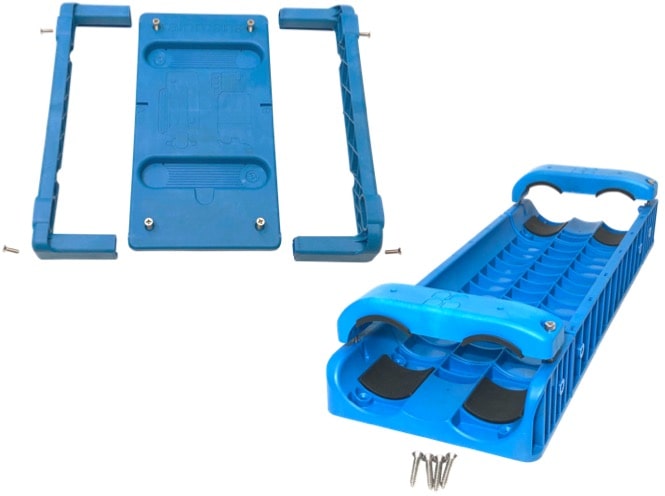
Often one of the difficulties common with a watermaker installation is the physical mounting of various components. Rainman has developed a fibreglass reinforced nylon mounting system to ease these challenges. Simply screw down the seats with self-tapper screws and the Rainman systems easily snap into place.
More details can be found in the videos below or in the installation guide, but you can expect to save hours off the installation process relative to other systems.
Plumbing Installation Kit
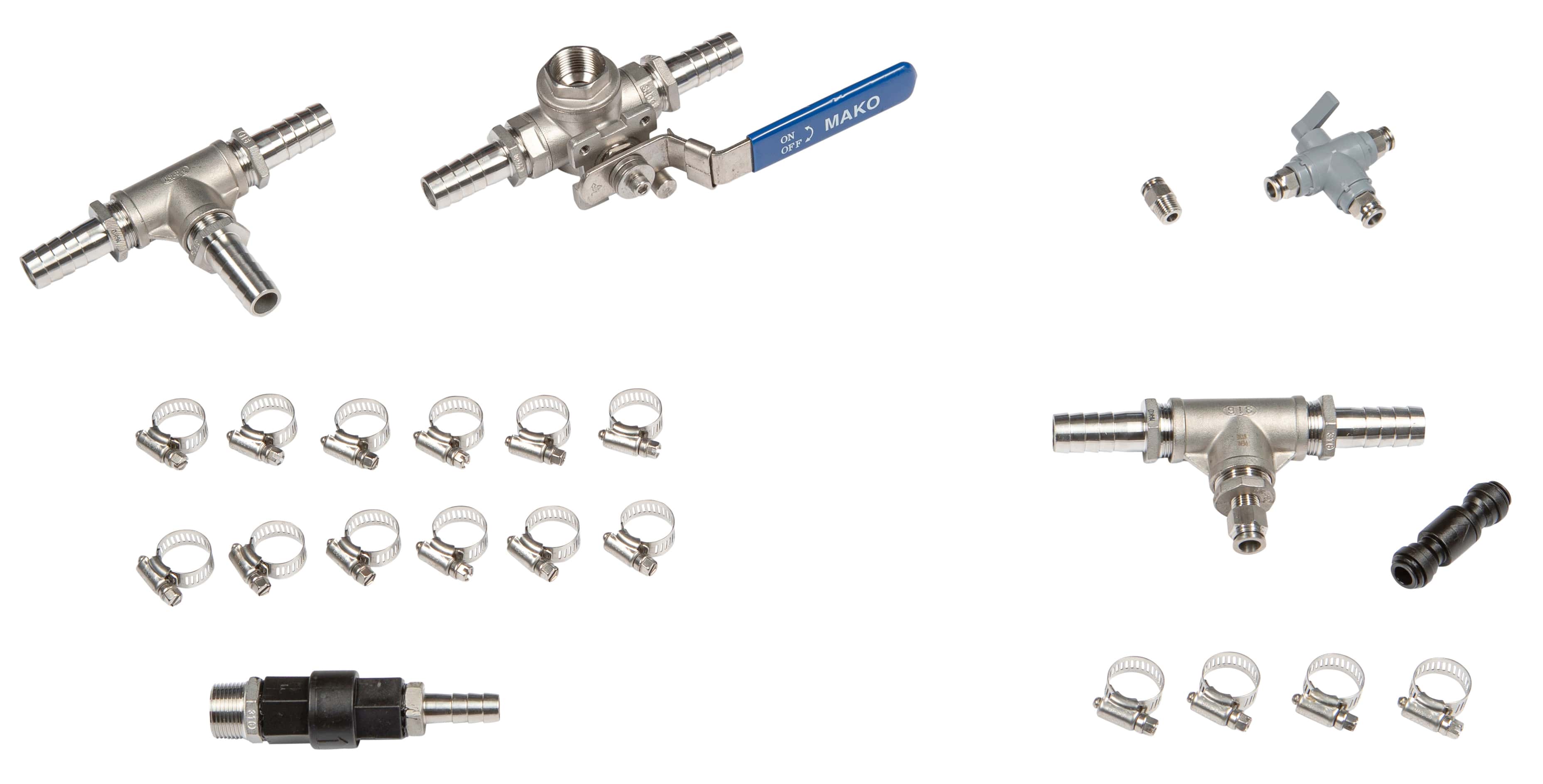
The Rainman Modular watermaker includes a plumbing kit that is designed to fulfil most of the requirements for your installation. Every boat is different, so there may be some parts to source yourself. Some of these customer sourced parts can include a sea strainer or fittings to adapt Rainman to fittings in your plumbing system.
More details of what is included in this kit can be found on the accessories page.
Technical Skills Required for Installation
While most customers will have their system installed professionally, there is no reason you can’t undertake the job yourself. The skills required include the use of hand and power tools, cutting in to various water lines, and routing soft plumbing and electrical cabling throughout your vessel.
The installation guide will assist in determining if you wish to do the job yourself.
Maintenance Requirements
While there is limited maintenance on your Rainman watermaker, there are a few things that should be looked after to ensure a long life of your system.
When storing system:
- Fresh water flush and pickle the system when storing it for more than a couple days. This may sound complex, but it is an easy five minute process with no specialist knowledge required. Alternatively, install the autoflush system to avoid the need for manually performing this task.
5-50+ hours of use:
- Change the non-proprietary prefilter after 5-50+ hours of use, depending on cleanliness of the source water.
1-2 years:
- Change non-proprietary impeller in the lift pump after a year or two, depending on use.
- Change the high pressure pump oil each 300 hours of use, using SAE-30 weight oil.
5-10 years:
- Change the non-proprietary sized reverse osmosis membranes after 5-10 years.
- If your system starts losing performance, the non-proprietary pump seals may eventually require replacing.
Spares and Consumables
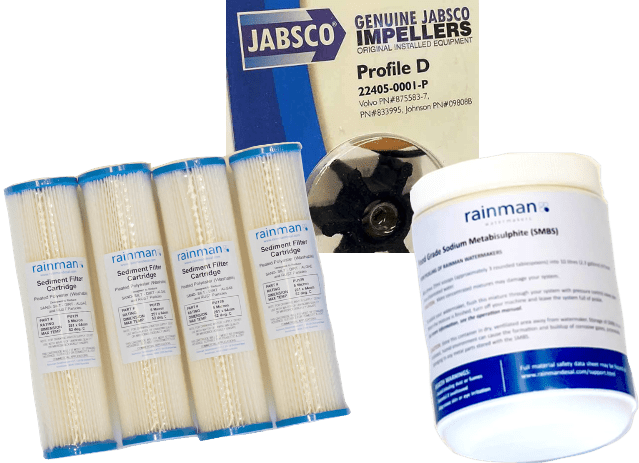
Your new Rainman system will arrive with enough spares and consumables to keep you going for a while, so most customers do not need to order more with initial purchase. There are a variety of items you will need over time to keep your system running for many years.
Specifications Comparison Table
The following table compares the specifications of the different Rainman modular systems. It also has the option to bring other types of Rainman systems into the comparison.
Use “Select Columns” to choose systems for comparison.